

Industrial floors face constant stress from heavy machinery, forklifts, chemical spills, impact loads, and continuous foot traffic. Ordinary concrete floors often develop cracks, dust, uneven surfaces, and wear over time. As a result, businesses require a flooring solution that offers exceptional durability, high compressive strength, and long-term protection.
Epoxy resin screed has become one of the most reliable flooring systems for industries that demand superior performance. It creates a dense, seamless, and highly durable surface capable of handling the toughest working conditions while minimizing maintenance costs.
Whether you manage a manufacturing facility, warehouse, pharmaceutical plant, food processing unit, automobile workshop, or logistics center, choosing the right flooring system directly impacts operational efficiency and workplace safety.
This complete guide explains everything you need to know about Epoxy Resin Screed, including its composition, advantages, applications, installation process, maintenance requirements, and why it remains the preferred solution for heavy-duty industrial floors.
What Is Epoxy Resin Screed?
Epoxy resin screed is a heavy-duty flooring system made by blending epoxy resin with graded quartz or silica aggregate and a hardener. The aggregate is what separates a screed from a standard epoxy coating — it gives the finished floor load-bearing thickness rather than just a protective film.
The finished surface becomes:
- Extremely hard
- Highly impact resistant
- Seamless
- Dust-free
- Chemical resistant
- Easy to clean
- Long-lasting
Because of these qualities, industries around the world rely on epoxy screeds for demanding environments.
Types of Epoxy Resin Screed Systems
Not all screeds are the same. The right type depends on traffic load and budget.
| System Type | Thickness | Best For | Approx. Compressive Strength |
|---|---|---|---|
| Self-Leveling Epoxy Screed | 2–4mm | Light-to-medium traffic, offices attached to plants | 45–50 MPa |
| Broadcast (Flake) Epoxy Screed | 4–6mm | Warehouses, retail-adjacent industrial units | 50–55 MPa |
| Heavy-Duty Trowel Screed | 6–9mm | Forklift traffic, manufacturing floors | 55–65 MPa |
| Anti-Static (ESD) Epoxy Screed | 4–6mm | Electronics, pharma cleanrooms | 50–55 MPa |
Why Heavy Duty Floors Need More Than Ordinary Concrete
Concrete provides structural strength, but it has limitations when exposed to industrial operations.
Common problems include:
- Surface dusting
- Abrasion
- Cracking
- Oil penetration
- Chemical attack
- Water absorption
- Forklift tire damage
- Uneven surfaces
These issues increase repair costs, reduce productivity, and create workplace hazards.
An industrial epoxy resin screed eliminates these problems by providing a dense protective layer that shields concrete from mechanical and chemical damage.
Benefits of Epoxy Resin Screed
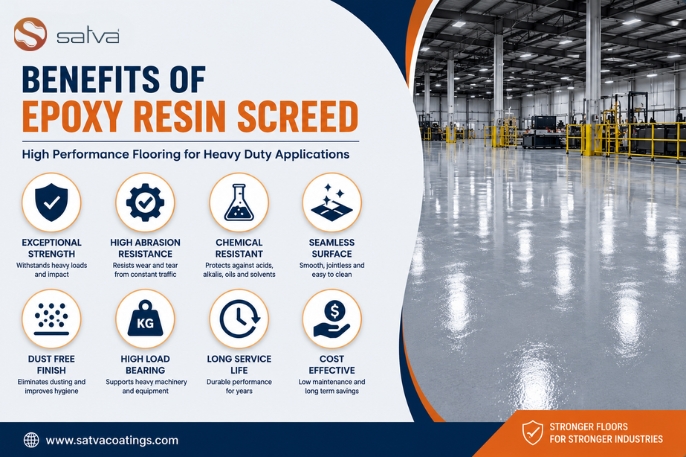
Exceptional Mechanical Strength
Heavy equipment generates tremendous pressure on industrial floors.
Epoxy screeds withstand the following:
- Forklift movement
- Steel wheel traffic
- Heavy machinery
- Storage racks
- Constant loading
- Industrial vehicles
This reduces floor damage and extends service life.
Superior Abrasion Resistance
Industrial operations continuously wear down ordinary flooring.
An epoxy screed provides excellent abrasion resistance, making it ideal for:
- Logistics hubs
- Production units
- Warehouses
- Engineering plants
- Automobile industries
The surface remains smooth for years even under constant traffic.
Outstanding Chemical Resistance
Industrial facilities often encounter the following:
- Acids
- Alkalis
- Oils
- Solvents
- Grease
- Cleaning chemicals
A quality chemical-resistant flooring system protects concrete from chemical deterioration while maintaining structural integrity.
Long Service Life
One of the biggest advantages is durability.
With proper installation and routine maintenance, epoxy screeds can last for many years without major repairs.
That means:
- Lower maintenance costs
- Reduced downtime
- Higher return on investment
Seamless Surface
Joints often trap dust, bacteria, moisture, and dirt.
Epoxy screeds create a seamless floor that improves hygiene while making cleaning faster and easier.
This benefit is especially valuable for:
- Pharmaceutical facilities
- Food processing plants
- Healthcare industries
Dust-Free Flooring
Concrete naturally releases dust as it ages.
Dust contaminates products, damages machinery, and affects indoor air quality.
An epoxy screed permanently seals the concrete surface and prevents dust formation.
High Load Bearing Capacity
Heavy industrial environments require flooring capable of supporting significant loads.
A high-strength epoxy screed performs exceptionally well under the following:
- Heavy machinery
- Storage systems
- Industrial equipment
- Continuous pallet movement
Where Epoxy Resin Screed Is Commonly Used
Because of its outstanding durability, epoxy screeds serve multiple industries.
Manufacturing Plants
Production units require strong floors that resist wear, impact, and chemicals.
Epoxy screeds provide reliable long-term performance.
Warehouse Flooring
Modern warehouses experience constant forklift movement.
A durable flooring system minimizes maintenance while improving operational efficiency.
Food Processing Facilities
Food industries require hygienic, seamless, and easy-to-clean flooring.
Epoxy screeds help maintain strict cleanliness standards.
Pharmaceutical Industries
Dust-free flooring is essential for pharmaceutical manufacturing.
Epoxy screeds support contamination control and simplify sanitation.
Automobile Workshops
Workshops frequently experience oil spills, dropped tools, tire movement, and chemical exposure.
Epoxy screeds withstand these demanding conditions.
Engineering Industries
Heavy fabrication work creates high mechanical stress.
Epoxy screeds protect the concrete beneath while improving workplace safety.
Chemical Processing Plants
Chemical-resistant flooring prevents aggressive substances from damaging concrete surfaces.
Logistics Centers
Continuous loading and unloading operations require flooring capable of resisting constant traffic and impact.
Epoxy Screed vs PU Screed vs Cement Screed
| Factor | Epoxy Resin Screed | PU (Polyurethane) Screed | Cement Screed |
|---|---|---|---|
| Compressive Strength | 45–65 MPa | 40–55 MPa | 20–30 MPa |
| Thermal Resistance | Up to 60°C | Up to 120°C | Up to 80°C (untreated) |
| Chemical Resistance | Excellent | Excellent (better with acids) | Poor |
| Cure Time (foot traffic) | 24–48 hrs | 12–24 hrs | 5–7 days |
| Typical Cost (India, per sq ft) | ₹180–₹350 | ₹250–₹450 | ₹60–₹120 |
| Best For | General industrial, warehouses | Food/beverage plants (thermal shock) | Low-traffic, budget projects |
How to Choose the Right Epoxy Resin Screed
Selecting the right system depends on several factors.
Consider:
- Traffic intensity
- Chemical exposure
- Floor thickness requirements
- Operating temperature
- Moisture conditions
- Cleaning procedures
- Load capacity
- Industry regulations
Consulting an experienced flooring manufacturer helps identify the most suitable solution.
Installation Process of Epoxy Resin Screed
Proper installation determines long-term performance.
Surface Inspection
Professionals first inspect the concrete.
They check:
- Moisture
- Cracks
- Surface contamination
- Structural integrity
Any defects receive appropriate repairs.
Surface Preparation
Mechanical grinding or shot blasting removes weak concrete and contaminants.
A properly prepared surface ensures excellent adhesion.
Priming
An epoxy primer penetrates the concrete and strengthens the bond between the substrate and screed.
Mixing the Materials
The resin, hardener, and graded aggregates are mixed carefully using the recommended ratios.
Accurate mixing ensures consistent performance.
Screed Application
The mixed material is spread uniformly using specialized tools.
Experienced applicators maintain the required thickness throughout the floor.
Leveling
The surface is compacted and leveled to eliminate air pockets and achieve a uniform finish.
Curing
The flooring cures according to environmental conditions.
Once fully cured, it becomes ready for industrial service.
Common Installation Mistakes & Failures
- Skipping moisture testing — screed applied over damp concrete (above 4% moisture) leads to blistering and delamination within months.
- Incorrect mix ratio — under-mixing hardener causes a soft, tacky surface that never fully cures.
- Applying below 15°C — slows cure dramatically and can cause poor adhesion; most manufacturers specify a 10-35°C application window.
- Rushing the recoat window — applying a topcoat outside the 8-24 hour tack-free window causes delamination between layers.
- Ignoring expansion joints — failing to carry structural joints through the screed leads to cracking under thermal movement.
Why Businesses Prefer Industrial Epoxy Resin Screed
Industries increasingly choose epoxy screeds because they provide:
- Exceptional durability
- Lower maintenance costs
- Improved workplace safety
- Better aesthetics
- Chemical resistance
- Dust-free performance
- Long operational life
- Excellent return on investment
These benefits make epoxy screeds a practical choice for demanding industrial environments.
Conclusion for Industrial Epoxy Resin Screed Flooring
Industrial facilities require flooring systems that withstand heavy traffic, impact, chemicals, and continuous operational demands. Epoxy resin screed provides a dependable solution by combining exceptional strength, durability, and long-term performance in one seamless system.
From warehouses and manufacturing plants to pharmaceutical facilities and engineering industries, epoxy screeds deliver reliable protection while reducing maintenance costs and extending the lifespan of concrete floors. By choosing high-quality materials and professional installation, businesses can improve safety, productivity, and operational efficiency.
If you are planning a durable industrial epoxy resin screed solution for your facility, Satva Coatings offers high-performance flooring systems tailored to demanding industrial environments, ensuring lasting protection and value for your investment.
FAQ Section
1. What is Epoxy Resin Screed?
It is a high-strength industrial flooring system made from epoxy resin, hardeners, and graded aggregates that provides durable, seamless, and chemical-resistant protection.
2. Is epoxy screed suitable for warehouses?
Yes. It performs exceptionally well in warehouse flooring because it resists forklift traffic, abrasion, and heavy loads.
3. Can epoxy screed resist chemicals?
Yes. It offers excellent resistance to oils, solvents, acids, alkalis, and many industrial chemicals.
4. What are the main benefits?
Epoxy resin screed offers exceptional strength, high impact resistance, excellent chemical protection, and long-lasting durability. It also creates a seamless, dust-free surface that is easy to clean, making it an ideal flooring solution for warehouses, factories, and other heavy-duty industrial environments.
5. How is it different from regular epoxy?
Epoxy resin screed is thicker, stronger, and mixed with aggregates, making it suitable for heavy-duty industrial floors, while regular epoxy is a thin coating mainly used for light to medium-duty protection and finishing.
6. Is epoxy screed easy to maintain?
Yes. Its seamless surface simplifies cleaning while reducing dust accumulation and maintenance requirements.
7.How thick should epoxy resin screed be?
2-4mm for light-to-medium traffic, 4-6mm for warehouses, and 6-9mm for heavy forklift or machinery traffic.